“A general good feeling”
That is what smaller companies base the success of their trade-fair appearance on, according to the current exhibitor outlook by AUMA, the association of the German trade fair industry. Not leads, not meetings, not pipeline — a feeling.
That was unproblematic for a long time. It no longer is.
- 64 % — name rising costs as their biggest challenge
- 54 % — report increased budget pressure
- 27 % — have to justify fairs internally against digital channels
- 49 % — measure success by leads and contacts
Anyone who has to defend a trade-fair appearance with a good feeling loses the argument.
The fair itself is not in question: around 98 per cent of exhibitors see it as an indispensable platform, and at capital goods trade shows more than 85 per cent rate their participation as important or very important. It is not about whether, but about proof.
We are at trade fairs because our customers exhibit there: most recently at K and ILA, and in October at Fakuma and Chillventa. We talk to marketing, sales and project management as much as to the booth-building partners we implement stands with. And afterwards we see which content was actually viewed at the booth. One thing stands out above all: what gets hectic on the third day of the fair almost always goes back to a decision nobody made months earlier.
What this list is — and what it is not. Booth construction, hall logistics, connections, permits and booth design are deliberately not covered in detail here. That is the craft of your booth builder and your organiser, and they do it better than we do.
And one more thing up front: the starting point is rarely a new tool, but what you already have. Sales documents, product content, references: much of it can be tailored for the booth instead of built from scratch. This list covers what marketing and sales hold in their own hands: goals, team, content, digital stations, leads and follow-up. 24 points in three phases. Cross out what does not apply to you.
If time is short, it comes down to five. The list below is complete, but not sorted by urgency. With a tight budget and little lead time, these five points decide the outcome. The numbers refer to the detailed points further down:
- Point 2 — one number per fair objective
- Point 3 — definition of a qualified lead
- Point 5 — booth team trained and enabled
- Point 6 — full costs including internal working time
- Point 16 — follow-up planned in advance
Everything else improves the appearance. These five decide whether it can be proven afterwards.
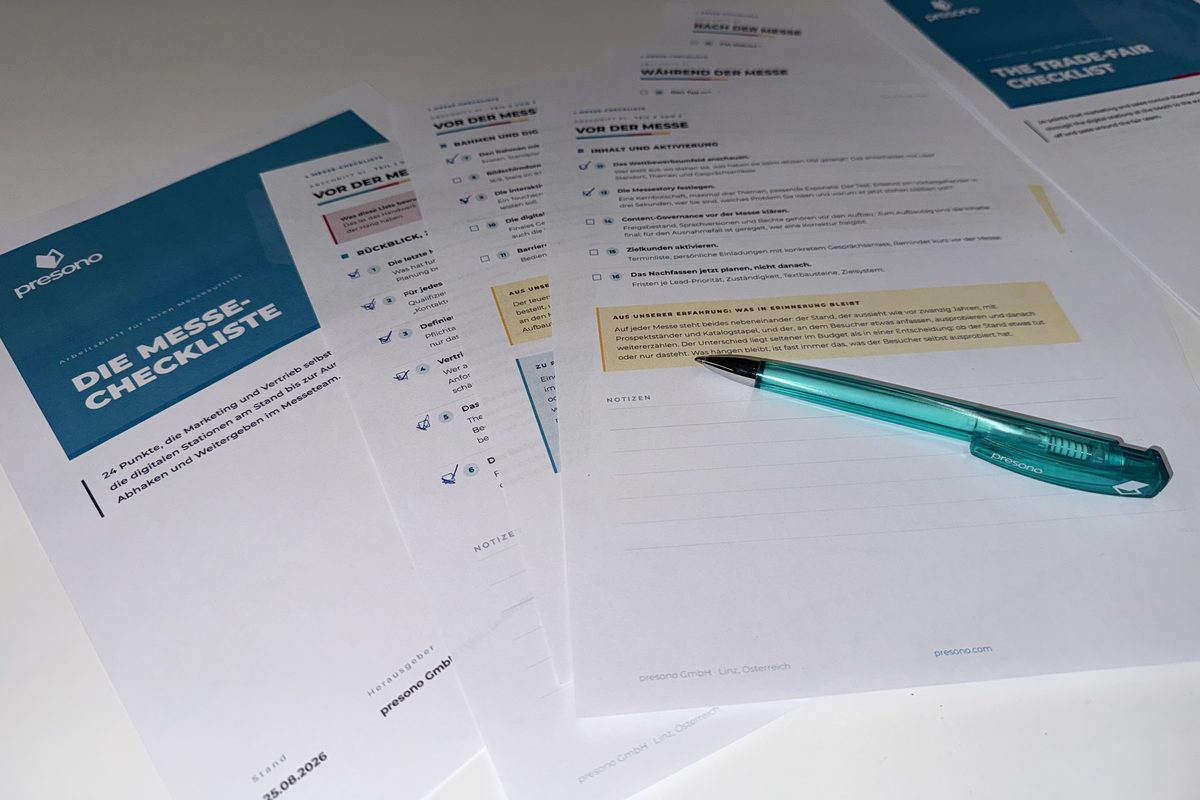
Rather tick it off on paper? The whole list is also available to take away: worksheet as a PDF to print, six pages with room for notes. The article below explains the points in detail.
Before the fair
Open up whatever you need right now — each section shows its points in detail. If you prefer ticking off on paper, take the worksheet.
Review, goal, team, budget · Points 1–6 (6 points)
- 1. Review the last fair. What worked, what did not, which points from that debrief are still open? Planning starts with the retrospective, not with a blank page.
- 2. Set a concrete number for every fair objective. A fair rarely has just one job. Set a number per purpose: new qualified leads, meetings with existing customers, partner and press conversations. Around half of companies rate fair success primarily by leads, contacts and new business; about 20 per cent fall back on visitor numbers.
- 3. Define what counts as a qualified lead. Which details must be captured, which stages exist, who in sales takes over, by when? Without that definition the evaluation afterwards is a matter of taste, and that is exactly where most trade-show appearances lose their effect. Also record what is explicitly not a lead: someone who only enters the prize draw does not belong on the same list as someone with a project, a timeframe and a budget.
- 4. Involve sales and the booth team early. The people who will stand at the booth know best which questions come up and which arguments land. Collect requirements and ideas before the concept is fixed, instead of handing them out in the briefing. It sharpens the content, and it makes the team carry the appearance rather than just operate it.
- 5. Train and enable the booth team. Clarify topic ownership and lead responsibility, and add hands-on training on setting up and operating the digital stations, the interactive elements and the content. Whoever is to run them at the booth must have run them once beforehand. Anything else shows on the first day.
- 6. Calculate the budget in full. Space, construction, services, travel, content production, technology and internal working time. That sum is later the reference for the only number that really helps in a budget discussion: cost per qualified lead. Separate what is one-off from what recurs at every fair. That is where it is decided whether an appearance gets cheaper the more often you exhibit.
Framework and digital stations · Points 7–11 (5 points)
- 7. Agree the framework with booth builder and organiser. In one go: deadlines and registration cut-offs, floor plan, screen positions and formats, power and network, delivery, contacts, handover. You do not have to know how to do it yourself, you only have to say early what digital content should go in.
- 8. Fix screen formats before content production. 16:9, a vertical totem in 9:16, a video wall in a special format, a tablet in portrait? Content does not adapt itself to a different aspect ratio. Viewing distance belongs here too: what is legible at your desk is far from legible at three metres.
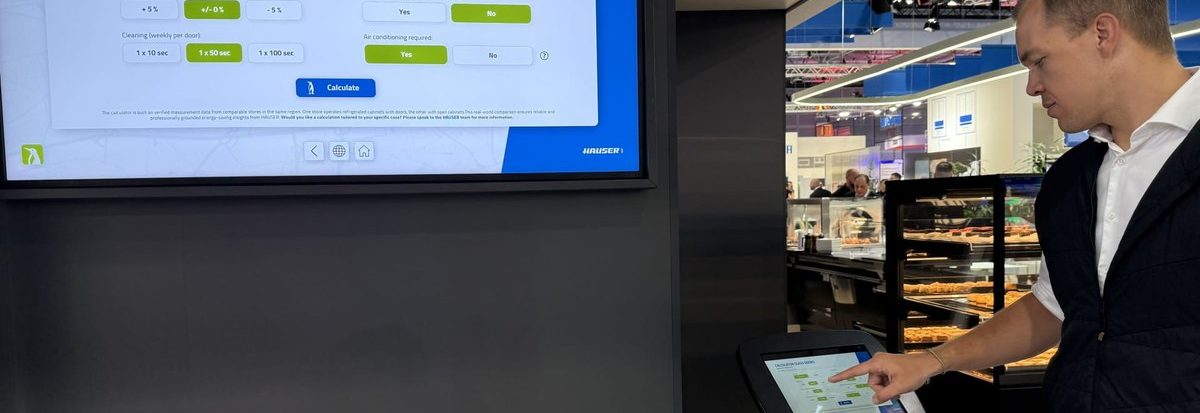
- 9. Plan the interactive stations with a clear job. A touchscreen nobody touches is expensive wall decoration. Decide in advance what the station should achieve: explain the product, qualify a need, bridge the wait or simply be remembered. It works best when the interaction starts at the exhibit rather than at the screen.
- 10. Test the digital stations under real conditions. Final device, real resolution, legibility from booth distance, autostart and automatic reset, PIN protection, the offline case and a spare device. The offline test matters most: pull the plug and see whether everything really keeps running, videos and large images included.
- 11. Consider accessibility. Reachable operating height, sufficient contrast, type sizes legible from two metres, and a quiet zone for longer conversations. Organisers such as Messe Frankfurt now cover this in their exhibitor guidelines.
Content and activation · Points 12–16 (5 points)
- 12. Look at the competitive field. Who is exhibiting, where are they, what did they show last time? That shapes your location, your topics and your conversation openers, and it shows you which claims everyone in the aisle is already making.
- 13. Define the fair story. One core message, three topics at most, the matching exhibits, and a look at what can be reused from existing content. Ask not only what you want to show, but what your customers are dealing with right now. The test is the passer-by’s view: can someone tell within three seconds who you are, which problem you solve and why it is worth stopping now? If one of the three answers only comes up in conversation, for most people it comes too late.
- 14. Settle content governance before the fair. Approval status, language versions, image and logo rights, responsibilities. All of that belongs before the build-up. By set-up day the content is final; for the exceptional case it is clear who signs off a correction. Anyone who starts changing prices on the evening of the fair has a planning problem, not a tooling problem.
- 15. Activate target customers. Meeting list, personal invitations with a concrete reason to talk, a reminder shortly before the fair. Pre-booked conversations fill exactly the quiet hours, and a good 44 per cent of exhibitors name visitor activation as one of their biggest challenges.
- 16. Plan the follow-up now, not afterwards. Deadlines by lead priority, ownership, text modules, target system. Anyone who plans the follow-up only after the fair plans it exhausted.
From our experience: what people remember
At every trade show both kinds of booth stand side by side: the one that looks like it did twenty years ago, with a brochure rack and a stack of catalogues, and the one where visitors touch something, try it out and talk about it afterwards. The difference is rarely the budget but a decision: whether the booth does something or merely stands there. What sticks is almost always what the visitor set off themselves.
From our experience: settle formats before production
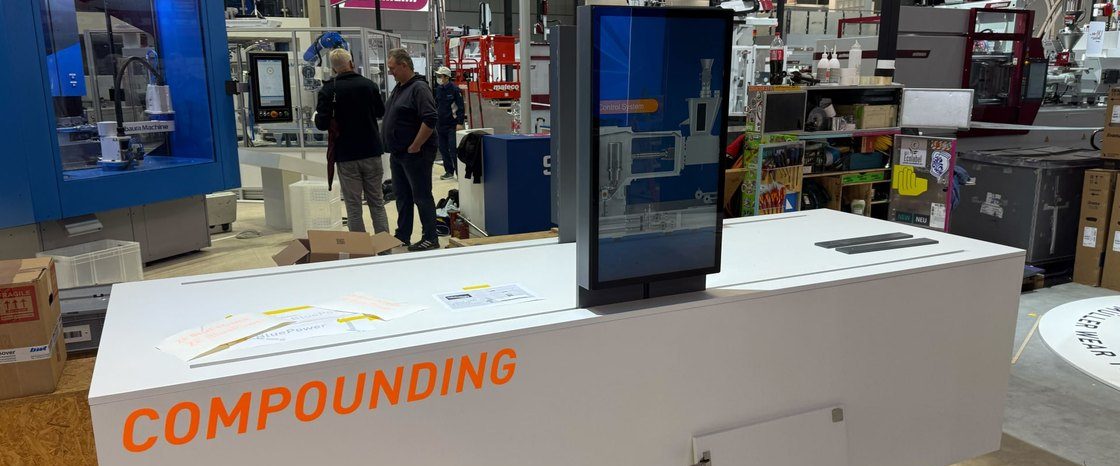
The most expensive setback we see again and again in digital trade-fair projects: the booth design is finished, the portrait totem is ordered, and the content exists in landscape. The rebuild then happens on set-up day or the night before, while the carpet is still being laid next door. Screen formats belong in the brief to the booth builder as a binding specification, agreed as part of the defined content concept. That saves exactly that night.
During the fair
During the fair · Points 17–20 (4 points)
- 17. Start the day with a walk-around. Ten minutes around your own booth with a visitor’s eyes: are all devices running, did the autostart complete, are the screens on the home page, is the content up to date, does the network work? Plus wiping the screens, restocking material, agreeing the priorities for the day and who has which meeting.
- 18. Capture every conversation with context. Not just who, but what they are interested in, which need, which next step, who takes over, by when. A stack of business cards without context is not a lead.
- 19. Hand over matching content after the conversation. Instead of a generic brochure, exactly what was discussed, ideally as a link, with no file to send and no software to install. It spares the visitor the pile of paper and you the promise “I’ll send that over”, which over four days of a fair turns into a list nobody works through.
- 20. Note competitors and market systematically. Which claims, which new products, which pricing arguments, and above all the questions visitors kept asking. That is market research for free, and it is lost if nobody writes it down.
From our experience: the offline and autostart test
A typical failure at the booth is not a defect but a screen that went into sleep mode overnight and that nobody notices in the morning because everyone is in conversation. The second is fair Wi-Fi. Fair Wi-Fi is two things: unreliable and expensive. Organisers charge well for a dependable line, which is why many exhibitors do not book one at all. That is perfectly fine, as long as the content runs offline. Anyone who depends on it pays twice: once for the line and once with the risk that it drops out during the product demo. Both can be checked beforehand: run the autostart once, pull the plug, look.
After the fair
After the fair · Points 21–24 (4 points)
- 21. Hold the debrief in the first week afterwards. Not on the day you get back, but while the impressions are still fresh: leads, frequent questions, objections, booth operations, competitor observations. From that come actions with owners and dates.
- 22. Follow up by priority. Hot contacts within one to two working days, everything else according to the stages defined in point 3. A single deadline for all leads is not prioritisation.
- 23. Evaluate what happened at the booth and afterwards. Which content was viewed how often and for how long, were the links you handed over opened and which parts? That turns gut feeling into a basis, and it delivers the arguments for the next budget round.
- 24. Measure success against the numbers from point 2. Qualified leads, meetings, pipeline contribution, cost per qualified lead. From that follows what changes next time, and what you take into sales in terms of content.
From our experience: speed and context
Two things decide the follow-up: how fast it arrives and how much context it carries. After four to eight weeks the fair contact has evaporated, however good the notes are. Conversely, fast but generic follow-up throws away all the preparation. Someone who follows up promptly and knows which topic was discussed at the booth and which documents were actually opened afterwards has a different conversation than someone who only has a name. That is exactly why it pays to hand things over digitally at the booth.
What digital stations can contribute
An interactive station has one solid advantage: it keeps visitors at the booth. Whoever taps, scans or moves something themselves stays longer, and discovers content along the way that you could never cover in a single conversation. It does not replace a sales conversation, but it bridges the minutes when nobody is free, and it gives the visitor something to do instead of letting them walk on. Playful is not a dirty word here: what someone set off themselves sticks better than what was demonstrated to them.
And sometimes it simply is not worth it. If your booth is small, the team is there throughout and the conversation happens at the exhibit anyway, a well-briefed booth team is the better investment than another screen. It can tip the other way too: a touchscreen nobody touches is expensive wall decoration. What works is interaction with a clear job: explain the product, qualify a need, arrange a meeting, hand over matching content. And one that starts at the exhibit rather than at the screen. Three designs we see in use at our customers’ booths:
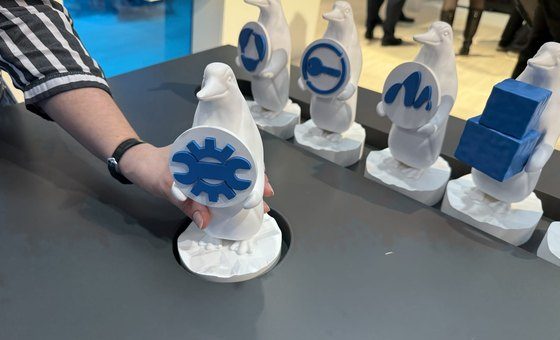
Scan & Show
A product placed on the scan surface calls up the matching content via NFC or barcode, switches the language or returns to the start. Online or offline. In use at CCL at drinktec
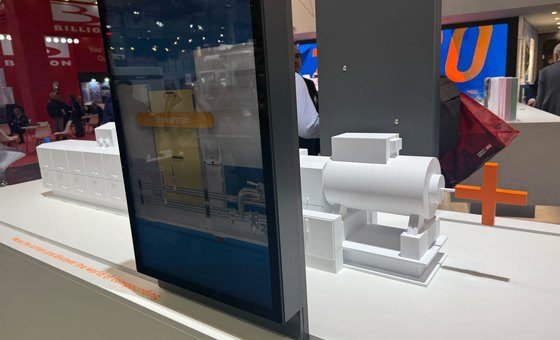
Glide & Show
A monitor on a rail that visitors move themselves; the presentation follows the movement. For timelines or a look inside a machine. The module in a demo video
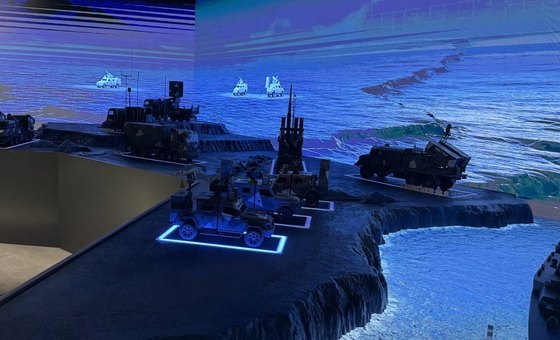
Show & Send
Signals from the presentation to the booth itself, for example LED strips highlighting the part of the machine being discussed. In use at DIEHL Defence at ILA
How much comes together at a single appearance is visible in our own usage data: at K 2025, ten companies using presono showed more than 2,000 presentations in eight days and presented over 16,000 slides. That is not an industry benchmark but our own measurement, yet it shows the volume of content a trade-fair appearance moves, and why reuse counts for more than new production.
What a standard solution does for the fair budget
Back to the cost pressure from the beginning. Interactive booth solutions are often built as one-offs, a programming project for this one trade show. That works until the next one: the content is out of date, the booth concept is different, and only whoever built it can change it. The effort comes round again.
A standard solution is not free, it costs on an ongoing basis, and individual designs come with a one-off setup. The difference lies elsewhere: the cost does not repeat per fair but spreads across several appearances, and you maintain the content yourself. That is effort too — only effort that stays in-house and is already done next time.
And now?
Points 1 to 16 belong in the coming weeks, not on set-up day. If you take only one of them away: point 3. The definition of what a qualified lead is decides whether you have an evaluation after the fair, or a good feeling.
To take away and tick off: worksheet as a PDF to print
What this looks like in practice is shown at presono for trade fairs & showrooms: customer examples from various industries and the most frequent questions on kiosk operation, offline capability and evaluation.
Appendix: the next trade-fair windows
Autumn 2026
Automechanika Frankfurt 08–12 Sep · AMB Stuttgart 15–19 Sep · InnoTrans Berlin 22–25 Sep · REHACARE Düsseldorf 23–26 Sep · ALUMINIUM Düsseldorf 06–08 Oct · Fakuma Friedrichshafen 12–16 Oct · Chillventa Nürnberg 13–15 Oct · ISPO 03–05 Nov (Amsterdam for the first time, instead of Munich) · Alles für den Gast Salzburg 07–10 Nov · BrauBeviale Nürnberg 10–12 Nov · electronica München 10–13 Nov · MEDICA Düsseldorf 16–19 Nov · Formnext Frankfurt 17–20 Nov · SPS Nürnberg 24–26 NovWinter and spring 2027
BAU München 11–15 Jan · boot Düsseldorf 23–31 Jan · ISM Köln 01–03 Feb · E-world Essen 16–18 Feb · EuroCIS Düsseldorf 16–18 Feb · Energiesparmesse Wels 05–07 Mar · Internorga Hamburg 12–16 Mar · embedded world Nürnberg 16–18 Mar · LogiMAT Stuttgart 16–18 Mar · IDS Köln 16–20 Mar · Hannover Messe 05–08 Apr · transport logistic München 26–29 AprMay and June 2027
LIGNA Hannover 10–14 May · interzum Köln 11–14 May · ACHEMA Frankfurt 14–18 Jun · GIFA Düsseldorf 21–25 JunDates without guarantee, as of August 2026. The links lead to the organisers’ websites and open in a new tab.
This article is based on our own trade-fair experience, customer projects and researched sources. AI tools supported the structuring and wording; content, figures and sources were editorially reviewed.