Company presentation structure at a glance
A company presentation (also called a corporate presentation or company profile presentation) introduces your company: what you offer, who you work for and why people can trust you. Everyone in your company uses the same presentation and adds to it for their own meeting:
- The core answers four questions: Who are you? What do you do, and for whom? What proves you can do it? Who is behind it? Four to six slides are enough.
- Modules come in when a meeting needs them: references, certificates, sustainability, technology or how you work together. And a core slide can stay out now and then.
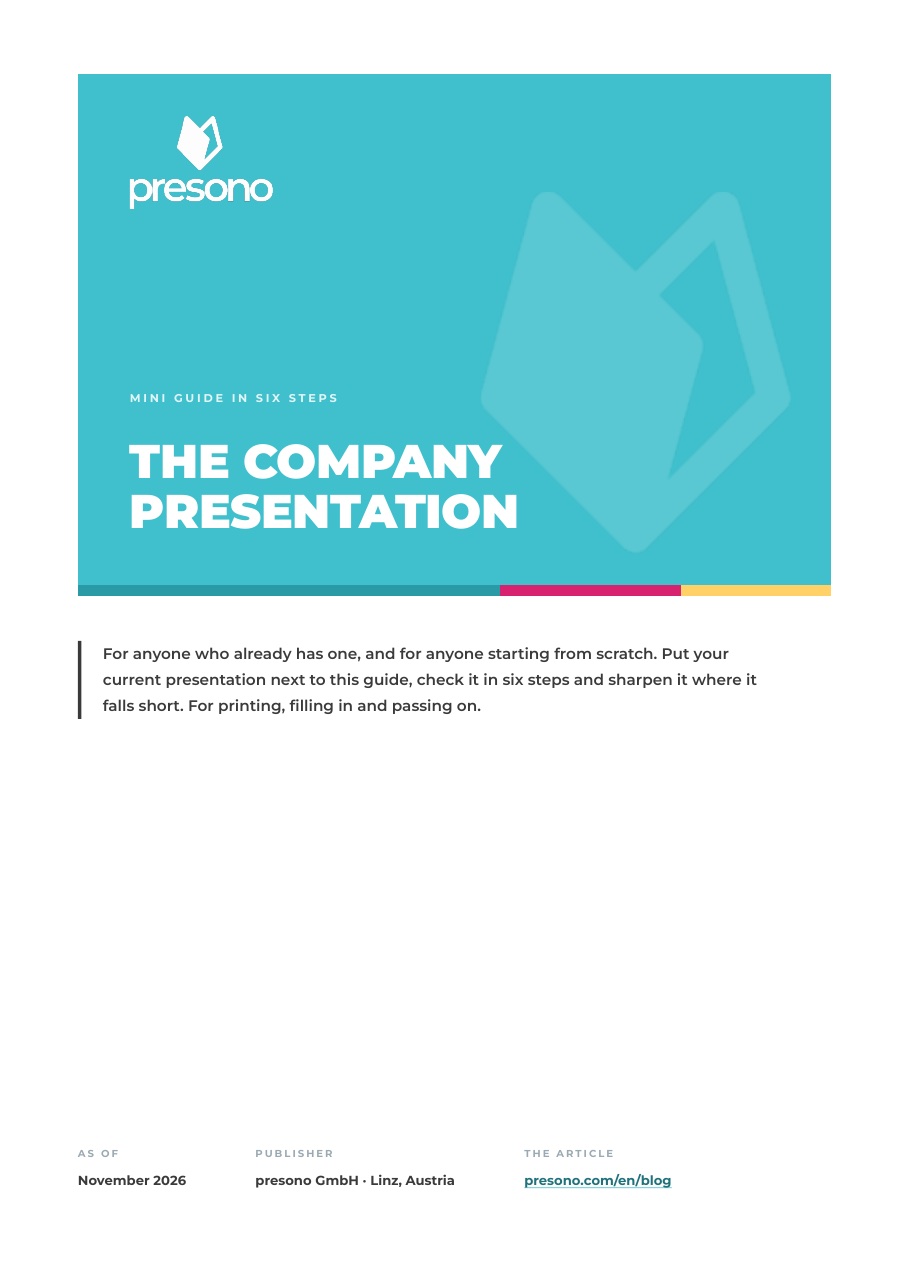
Download the mini guide as a PDF (4 pages)
In this guide:
- The core: what every company presentation should include
- One audience or several
- Modules: what to add for each meeting
- In the meeting and without you
- Upkeep and the annual review
- Frequently asked questions
“I read that last night”
Tuesday, nine o’clock, first meeting on Teams. You show slide two: founded 1978, 450 employees, plants in Germany, Poland and Mexico. The head of purchasing interrupts politely: “I read that last night. Can you also supply our plant in the Czech Republic?” The answer is on slide 18.
The head of purchasing came prepared; the presentation doesn’t pick up on it. That happens in many first meetings today: according to Forrester, 94 per cent of B2B buyers use AI in the buying process and know the basics before you start. So the founding year can stay on the slide. It just shouldn’t be the first thing you talk about.
We see a lot of company presentations, because customers build theirs in presono. The good ones have a core that is accurate everywhere, and they answer their audience’s questions early. Whatever a meeting needs on top comes in as a module.
The core: what every company presentation should include
Head of purchasing, technical manager or sales partner: anyone getting to know your company wants these four questions answered. For each one, we show a slide from our own presentation.
Who are you?
One sentence is enough to start with, the way a satisfied customer would describe you to a colleague.
- Not like this: “We are an innovative solutions provider with many years of experience.”
- Better: “We make precision parts for medical devices, from the first prototype to volume production.”
If you have already put your brand core into words, for instance in a mission statement, it belongs here. Show with an example what it looks like in everyday work.
Founding year, headcount and history belong in the core if they prove something: the headcount if someone wants to know whether you are big enough, the history if it shows what you can do. One slide is enough for your history. Nobody wants twenty slides of company history. Go into depth with your projects, and only when the customer asks.
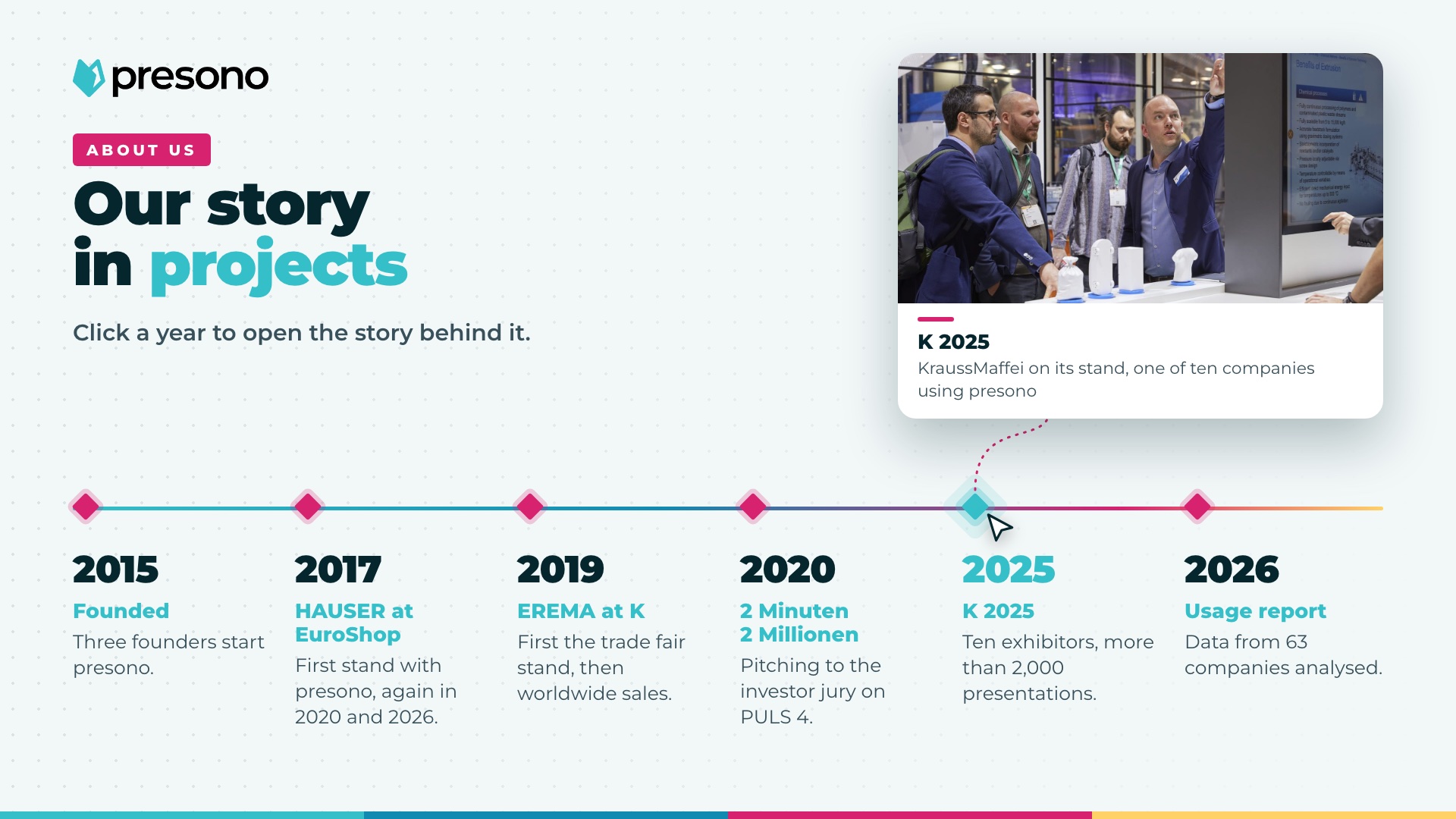 Our own timeline: eleven years on one slide. One click on a year opens the story behind it.
What do you do, and for whom?
For each service, spell out what the customer gets. Ten products in a row with the benefit saved for the end, and your audience has mentally moved on.
- Not like this: “Maintenance, spare parts, training, retrofits”
- Better: “Breakdown: our technician is with you within 24 hours, anywhere in Germany. Your line is down for less time.”
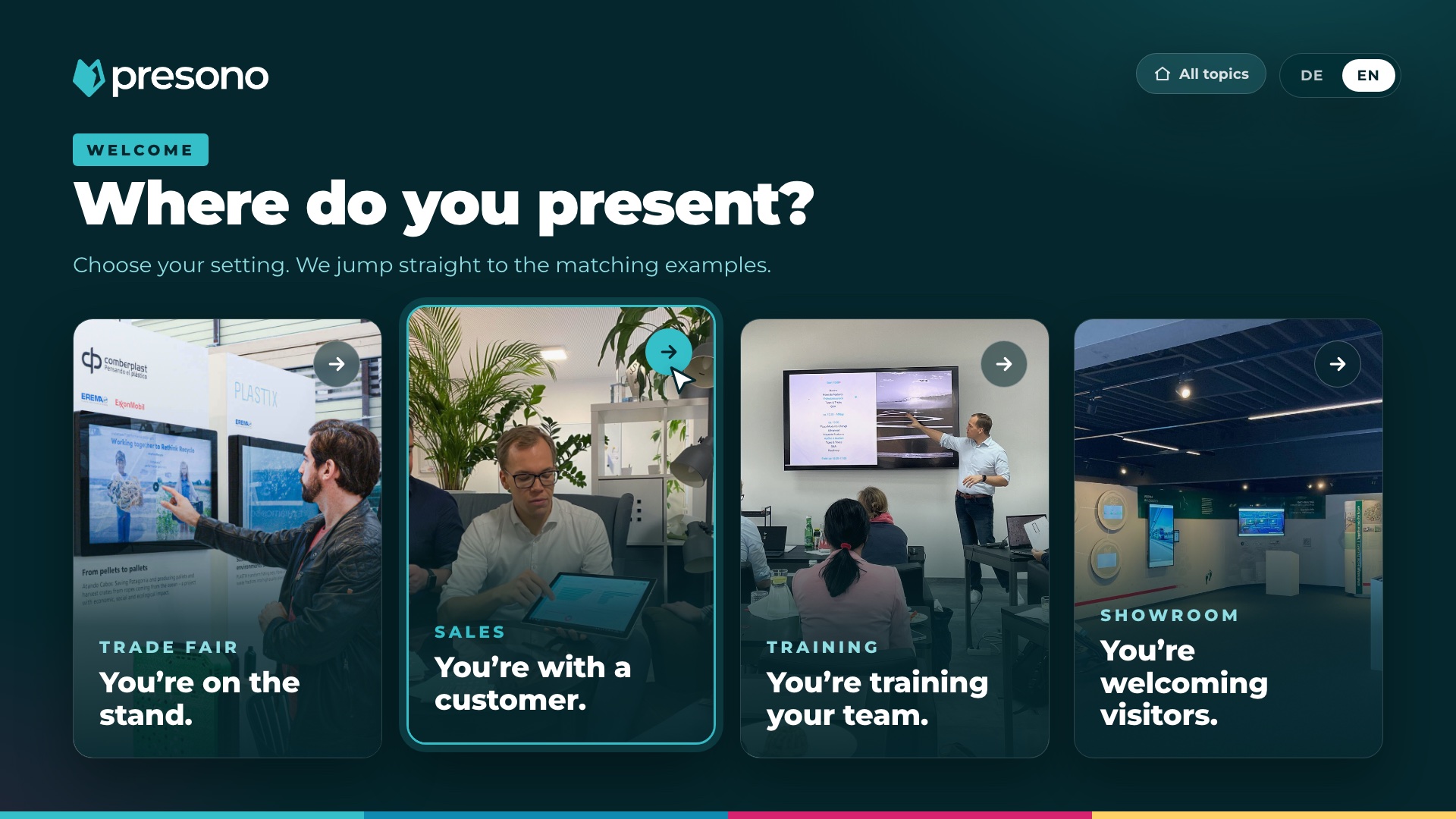 Our own start slide: everyone first picks where they present and gets to the matching examples in one click.
Say what you don’t do, too. “Batches of fewer than 500 aren’t economical for us.” You might lose an order that would never have been a good fit. In return, people believe the rest.
What proves you can do it?
This is about evidence: certificates, capacity, locations, service network, customers. A strong statement can stay on the slide. But the proof has to follow right behind it, or it remains a claim.
- The statement: “Highest quality and on-time delivery”
- The proof behind it: “Pilsen plant, IATF 16949 certified. In 2025 we delivered 98 per cent of order lines on the confirmed date.”
Test every statement with one question: could you back it up if someone pressed you? And a plant in Pilsen, little more than an hour from the head of purchasing’s plant, could have come early in the presentation instead of on slide 18.
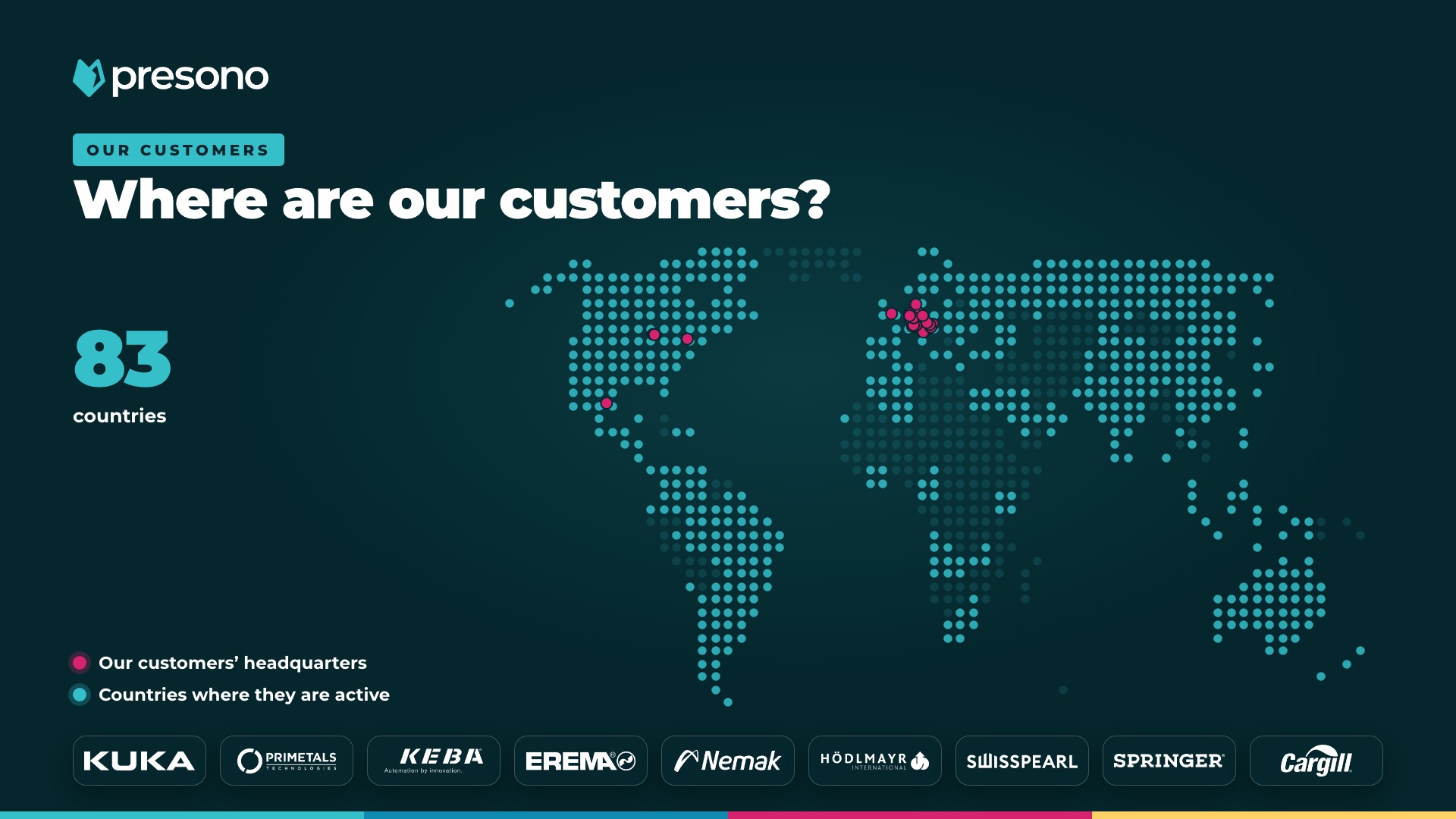 Our own customer map: the red dots are our customers’ headquarters, and the teal shows the 83 countries where they are active.
Who is behind it?
Hardly anyone outside your company cares about an org chart, but faces matter. At the customer’s end, one person rarely decides alone: purchasing, engineering and management, the buying centre, want to know how you are set up and who looks after them. Who belongs on this slide depends on the use case. For a plant builder it is project management and service, for a dealer network the contacts in each region, for partners the sales team. Expect this slide to go out of date fastest.
- Not like this: the org chart with 14 boxes
- Better: the three or four people your customer will deal with, with names and responsibilities
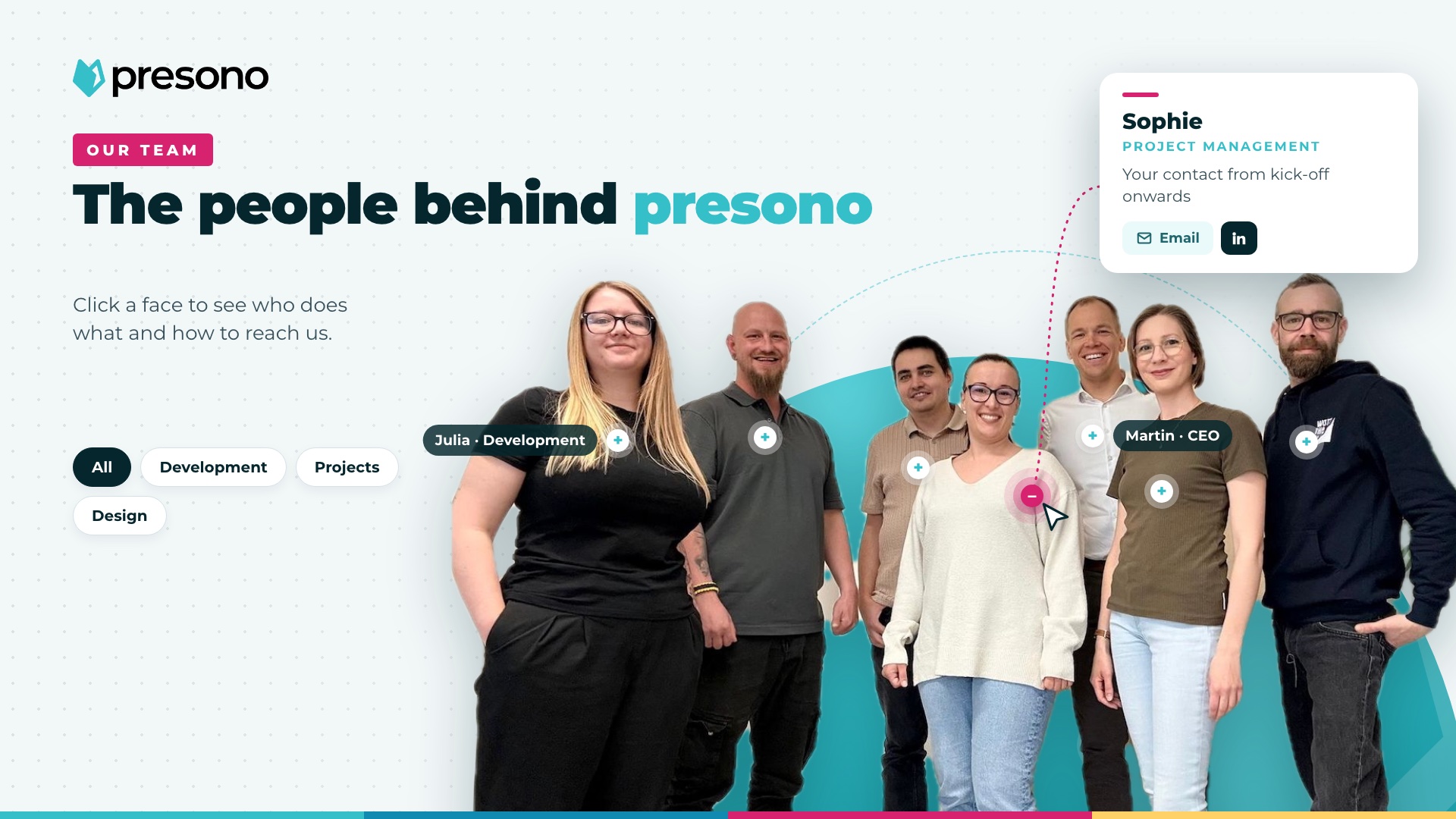 Our own team slide: the whole team in one photo. One click on a dot takes customers straight to the contact details of the person they deal with.
One audience or several
Depending on what you offer, you have one audience or several, such as industrial customers, dealers and partners. That does not mean you need a separate presentation for each. Most of your company presentation should work for everyone in the same way. Some content is specific to a customer or an industry: the benefit you stress, the matching reference, sometimes the choice of products. Sales or the specialist department adds that content as modules, and the rest stays the same.
Trade fairs, the website and video calls are formats, not audiences. The statements stay the same; only the amount of text and the presentation change.
Modules: what to add for each meeting
Everyone uses the company presentation: sales, management, partners, the trade fair team. Each of them adds to it for their own meeting. Sometimes slides come in, sometimes core slides stay out because the other side already knows you. What you add depends on what the other side wants to check:
| They ask | Module | What makes it convincing |
|---|---|---|
| Who have you done this for? | References | a project from their industry: situation, approach, result |
| Do you meet our requirements? | Certificates and quality | standard, scope, valid until |
| Where do you stand on sustainability? | Sustainability | figures rather than intentions, such as CO₂ per product |
| What is behind it technically? | Technology and products | what they improve for the customer, not just the data sheet |
| How does a project with you work? | Working together | steps, timings, what the customer contributes, contacts |
The questions that keep coming up in your meetings tell you which modules you need. Two examples from our own presentation:
Our reference slide on SPRINGER tells a project in three lines. Before the meeting, choose the case closest to the customer’s situation, and check beforehand whether you may name the customer. More on the example: roll-out at SPRINGER.
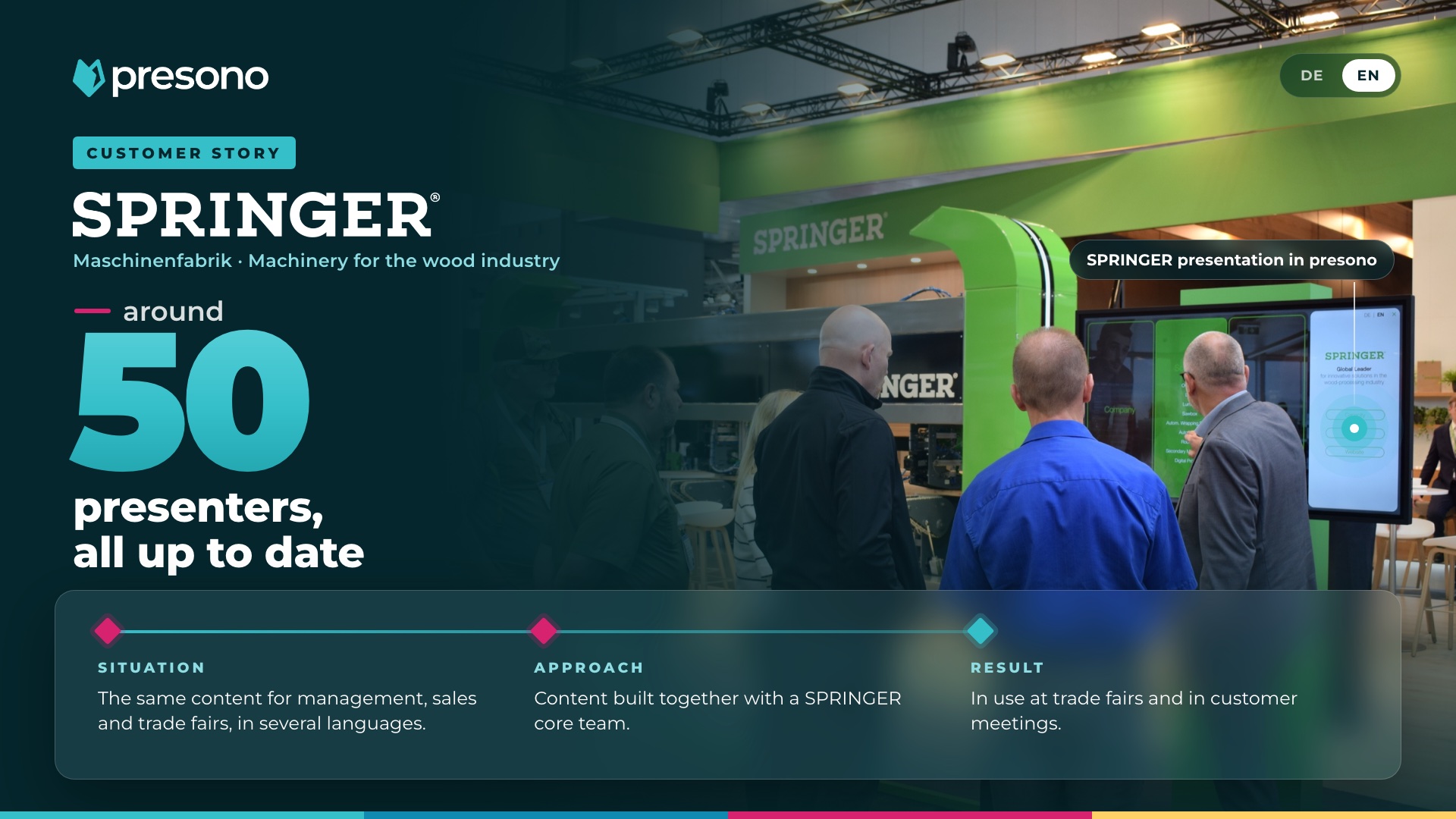 Our own customer story as a slide: situation, approach and result at SPRINGER, in three lines and with one number.
We show the project process when someone is planning a project with us for the first time. For existing customers we leave it out.
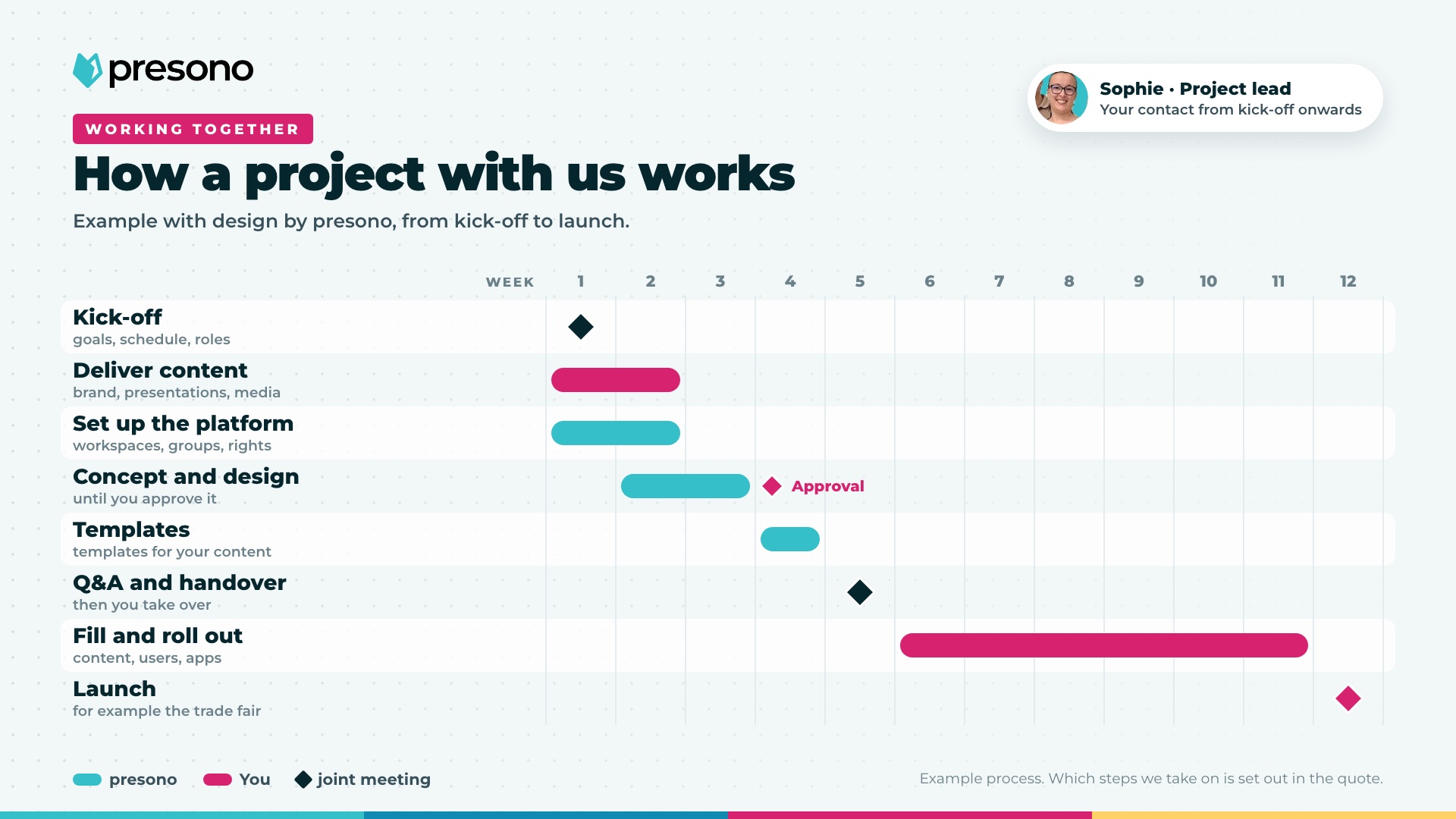 Our own project process as a timeline: the steps on the left, the weeks on the right. We do the teal parts, you do the red ones, and the diamonds are joint meetings.
Take modules from the same presentation instead of copying slides into separate files. Otherwise, after a year there are twenty versions, and none of them is fully correct.
In the meeting and without you
Open with what the other side cares about. You don’t need an agenda slide for that. Nobody cares about “Today we will cover the following twelve points”. An overview only earns its place if the customer uses it to pick where you start, as on our start slide above. On a video call in particular, the question “What matters most to you today?” brings the other side into the conversation early.
Delete the “Thank you for your attention” slide. It is a relic of the nineties and does not tell the customer what happens now. Your last slide belongs to the next step: “A plant visit in January. Anna Berger will agree the date with you by Friday.”
After the meeting, the head of purchasing forwards your presentation to engineering, the plant manager and management. According to Forrester, an average of 13 people are involved in a B2B buying decision. In our usage data from 63 companies, every presentation shared externally is opened ten times on average. Most of these readers never heard your talk. They need full sentences and, at the end, a name with a phone number. Usually one explanatory sentence on the slides that have to work without you is enough. On a trade fair screen it is the other way round, see our trade fair checklist.
Do the ten-minute test. Give the presentation to someone who does not know your company. Afterwards, ask them to say in two sentences what you offer and why people can trust you.

Upkeep and the annual review
Ask five colleagues for the presentation from their last customer meeting and put the files side by side. It’s fine that each of them has different modules. It gets annoying when the core drifts apart: three different headcounts, a product that no longer exists, a managing director who left long ago.

The rule against this: the core is fixed, the modules change. Marketing maintains and approves the core, and the experts confirm figures and technical data. Each module, such as references or certificates, has one person in charge.
When something on a slide changes, update the slide straight away. Once a year, go through everything; the turn of the year is a good time. Use the presentations that are actually being shown, not the ones on the server. Every slide gets a verdict, keep, change or delete, based on three questions:
- Is it still correct? Figures, locations, products, contacts, certificates
- Does it still help? Does the slide answer an audience question, or does sales skip it every time?
- Is anything missing? Which question keeps coming up in meetings without a slide that answers it?
Then the most awkward question of all: where are old versions still lying around? On laptops, in inboxes, with dealers, in the download area of your website?
Frequently asked questions
How many slides does a company presentation need?
Four to six for the core. On top of that come the modules the meeting needs. For a 30-minute first meeting, eight to twelve slides are a good frame.
Do I need a separate presentation for each audience?
Usually not. One company presentation is enough if the core works for everyone and sales or specialist departments add modules to it. Separate files for each audience go out of date quickly: at some point the headcount sits in five files, and one of them is wrong.
What is the difference from a sales presentation?
The company presentation answers: who are you, and can we rely on you? The sales presentation: why is this particular offer the right one for us? More on this in our overview of the most important types of presentation.
How often should a company presentation be updated?
Whenever something on a slide changes. And once a year in full.
Can AI create a company presentation?
A first draft, yes. What the AI does not know: which of your figures are still correct, which customers you may name and what your audience asks. It is useful as a cross-check: ask it what it knows about your company, and correct anything wrong on your website.
How to start
The mini guide as a PDF starts with the presentation you already have and takes you to a checked company presentation in six steps. Print it out and pass it round your team.
Many of our customers maintain their company presentation centrally in presono: marketing changes a core slide, and everyone who presents shows the new one at their next meeting. See presono for company presentations for how that looks.
Source: Forrester, The State of Business Buying 2026 (94 per cent of buyers use AI in the buying process; an average of 13 internal people involved in a buying decision). The examples in the text, including the names, are made up. All slides come from our own company presentation; map: Natural Earth. Photos: Kampus Production, Mikael Blomkvist and fauxels (Pexels).
This article is based on our own experience from customer projects and researched sources. AI tools supported the structuring and wording; content, figures and sources were editorially reviewed.